

|
|
Let's reach beyond the bluest skies, to the brightest
stars, on behalf of the University of Guelph's Smiling
Blue Skies Cancer Fund.
The
University of Guelph's Pet Trust, is a fund devoted to providing
financial assistance for the advancement of health, health care, and
quality of life, for companion animals. More than 120 studies into
naturally occurring diseases affecting companion animals, have been
carried out with Pet Trust funds. Pet Trust is overseen by an
independent Board of Trustees, and is administered by the Dean of the
Ontario Veterinary College (OVC). To date, Pet Trust funds have been
used for many special projects, including, investigations into common
health problems, the development of new diagnostics and therapeutic
techniques, studies involving the human-animal bond and animal behaviour,
and the upgrading of the Small Animal Clinic's Intensive Care Unit. Receipts
for tax credit purposes, are issued for all contributions to OVC's
programmes, under the University of Guelph's charitable status number.
Cancer is the most frequent cause of death in dogs. This is a truly
frightening thought. In an independent survey conducted by the Golden
Retriever Club of America, it was determined that over sixty per cent of
Goldens die from cancer. As one breeder pointed out, if you have Golden
Retrievers, you have had, have now, or will have a Golden with cancer.
It is a burden that we all share. In loving our dogs, whether pure
breeds or mixed breeds, we want the very best for them, in health, and
in sickness.
Every dollar donated to The Smiling Blue Skies Cancer Fund supports OVC's quest to find more and better ways to deal with and understand
this terrible disease. Pet Trust's aim is to spend as much money as
possible each year, so that they are having the maximum impact and doing
the most work possible. We have been told, that in sharing Blues' story,
we have helped to raise awareness of Pet Trust and OVC's fight against
cancer. Thanks to you, we are making a difference.
It has been said, that if we could hang all of our sorrows on pegs, and
were allowed to choose those we liked best, every one of us would take
back their own, for all the rest would seem even more difficult to bear.
Please help us to help our animal companions, and change the punch line
of the cruel joke we call Cancer.
The Smiling Blue Skies Cancer Fund is in loving memory of our beautiful
Blues Man, who taught us the true meaning of being a show dog. He
showed us how to live, love, laugh, and learn.

On-Line Donation Form, using VISA and
Mastercard for:
Smiling Blue Skies Animal Cancer Centre Capital Fund
Smiling Blue SkiesInnovative Research Fund
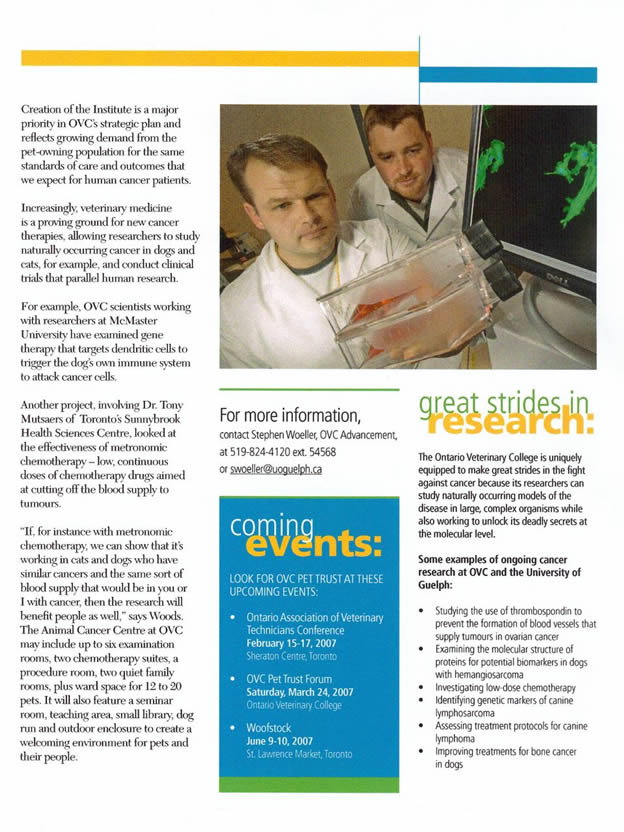
Smiling Blue SkiesAnimal Cancer Greatest Need
click here for the donation page!
or...
Please send your donations to: "The Smiling Blue Skies Cancer Fund"
Attention: Karen Tomchick
Alumni Affairs and Development Department
OVC Pet Trust
c/o Alumni House
University of Guelph
Guelph ON N1G 2W1
Please make sure to clearly indicate on your cheque, that your donation is
for The Smiling Blue Skies Cancer Fund. VISA and MasterCard are also accepted, and there is the
additional option of setting up a monthly bank account debit or monthly
credit card charge for up to one year.
If you would like to honour someone and/or a companion animal, by making
a donation to The Smiling Blue Skies Cancer Fund, please send your
donation, along with information about the receiving individual or
family (in whose honour or memory the donation is being made, your name
and address, and the address of the receiving individual or family).
All donations will be acknowledged by a receipt for tax credit purposes
and a very special limited edition card, with inscription.
If you have questions or require more information about Pet Trust,
please contact:
Karen Tomchick;
(519) 824-4120; Extension 54431
pettrust@ovc.uoguelph.ca
Karen Scott
Development Officer, Pet Trust
519.824.4120
Extension 54370
Barry Gunn
Communications Officer
Ontario Veterinary College
University of Guelph
Guelph ON N1G 2W1
Email:
bagunn@uoguelph.ca
519-824-4120 ext. 54414
Stephen Woeller, Director of Advancement for OVC, and Riley B. King, have work to do.


Dean Elizabeth Stone, Suzi, and Karen Stone

“That was Then.
This is Now.”
The Smiling Blue Skies ® Cancer Fund is 10 Years Old.
In 2010, YOU helped raise over $87,000 for Smiling Blue
Skies!!!
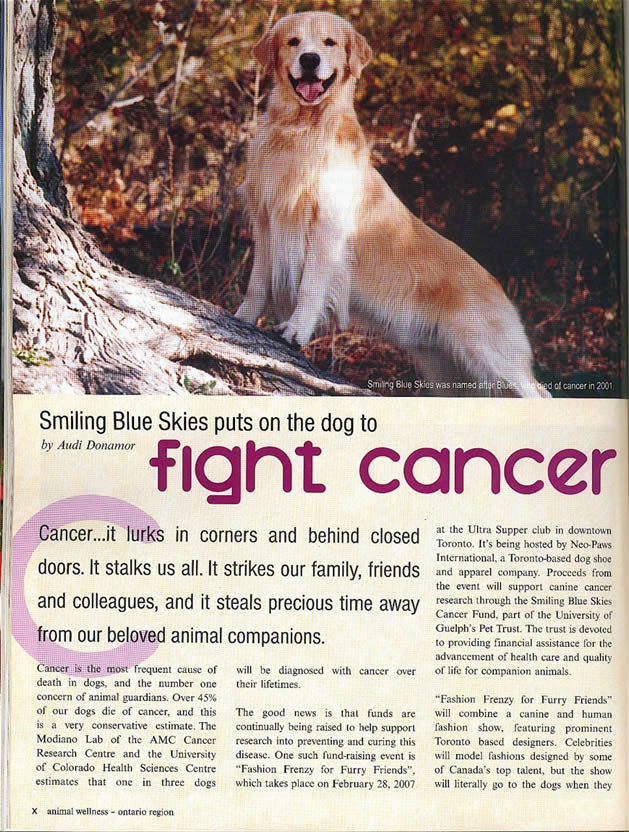
He was the sun and moon and stars to us. He was
our Smiling Blue Skies. Since the loss of our
Blues to lymphoma, in the spring of 2001, the Smiling
Blue Skies Cancer Fund has been supporting OVC Pet
Trust’s quest to find more and better ways to deal with
and understand the complex and devastating disease of
cancer.
Smiling Blue Skies is not about one dog, one cat, or one
person. It is about all of us, and thanks to
special people like you, we have been able to fund a
variety of exciting projects and promising studies.
Not only is the Smiling Blue Skies Cancer Fund busy, the
Smiling Blue Skies Fund for Innovative Research, has
opened even more doors. As Dr. Brenda Coomber, Co-director
of the University of Guelph's Institute of Comparative
Cancer Investigation reported, "Getting the ball rolling
on a novel concept can be a major challenge, and almost
every cancer researcher hears the same thing from
funding agencies . . . 'Come back when you have some
evidence you are on the right track.' The Smiling Blue
Skies Fund for Innovative Cancer Research fills an
urgent gap in OVC and the cancer centre's ability to
support creative cancer research at its most fragile and
vulnerable early stage."
This has included two recent research studies, under the
leadership of Dr. Gordon Kirby and Dr. Jinelle Webb,
partnered with three veterinary referral hospitals in
Ontario, for the first Hemangiosarcoma Validation Study.
The goal of the studies was to determine whether a
recently identified blood protein found at high levels
in dogs with hemangiosarcoma is useful as a diagnostic
tool for the presence of this cancer. While the
follow-up work for the test validation is still
underway, the researchers and clinical specialists are
very excited about their findings so far, and it is only
a matter of time (and a shorter time than we could have
ever imagined, so stay tuned) before a commercial
diagnostic test is available, that will be more
quantifiable and useful in a commercial setting.
We have also been able to fund the pilot project for
North America’s very first cancer registry for companion
animals. The Guelph Companion Animal Cancer
Epidemiologic Registry is population based and allows
for special studies about the occurrence of cancer among
dogs and cats, in select areas. Information gained
from the cancer registry can also provide clues about
cancer treatment and control in humans.
YOU have also been at the centre of Dr. Sarah Boston's
comparative studies and trials related to the treatment
of osteosarcoma, helped practitioners stay on top of
their game, through the use of continuing education
series, facilitated by Lifelearn, helped Dr. Paul Woods
study the potential of Nabidiolex, to attenuate nausea,
vomiting, and anorexia in dogs undergoing chemotherapy,
especially those diagnosed with lymphoma, and as many of
you already know, the University of Guelph is the first
Canadian institution to join the US National Cancer
Institute's Comparative Oncology Trials Consortium,
which positions the University of Guelph's Institute for
Comparative Cancer Investigation (ICCI) and the OVC
Cancer Centre with 19 other academic oncology centres at
the leading edge of cancer research in North America.
Smiling Blue Skies has evolved in so many ways over the
past 10 years. We never dreamed that a one page
memorial would turn into a real presence on the web,
that one walk in Muskoka, would turn into walks across
Canada, that companies like Canine Life, West Coast
Canine Life, and Endless Pawsibilities, would donate a
percentage of the proceeds from the sale of all their
products, to Smiling Blue Skies, that groomers and
trainers and doggie day cares, like Paws to Claws, would
donate tips to Smiling Blue Skies, that bake sales at
Awards Banquets would help fund studies and fill
tummies, that bottle collections would bring in
thousands, that the annual "Sashettes" calendar would
develop its own cult following, that obedience training
and cancer awareness would go hand in hand at Janice
Gunn seminars, that 2500 blue bracelets would find their
way to wrists across Canada and the United States and
beyond, joining us all together as Kindred Spirits, in
our quest to wipe out cancer, that agility groups across
Canada would embrace Smiling Blue Skies in so many ways,
from the distribution of clickers, to raffles, to
Smiling Blue Skies t-shirts for special events and one
of a kind pieces of Smiling Blue Skies jewelry for trial
judges, that regional and national clubs across Canada,
would share our passion and mission, making Smiling Blue
Skies a partner in a variety of events, and that
individuals and groups from coast to coast, across North
America, would reach out to us, so we could help them to
organize and host their own very special events.
Most important of all, Smiling Blue Skies continues to
offer 24/7 support to anyone whose life has been touched
by cancer. It doesn’t matter where you live.
Smiling Blue Skies will try to help you in any way they
can.
As Kathy Hay, Associate Vice-President, Advancement,
Alumni Affairs and Development, said in February of
2010: "Smiling Blue Skies is truly a beacon that is
helping to light the way to find a cure for such a
dreadful disease. The interdisciplinary cancer research
and training enabled by your continued support allows
future generations of cancer care specialists and
scientists to achieve new breakthroughs, new diagnostic
procedures and therapies. The generous support you
provide has immense implications for both human and
animal cancers. Thank you for your continued
leadership and advocacy."
Hot Off the Press: Smiling Blue Skies has just arranged
for 200 additional hours for a grief support counsellor
programme, through the University of Guelph, but just
because it's in Guelph, doesn't mean "you" have to be in
Guelph, to access this support service.
Thanks to all of you, we are going places we never could
have dreamed possible, back in the spring of 2001.
Together, we are reaching beyond the bluest skies and
brightest stars, to take bite after bite out of cancer,
until there is nothing left!
“Sky Manifesto”
Long live blue skies
Where hope is a kite
and dreams really
do come true.
* * * * * * * * * *
If Hope was a medicine, Love would surely be the cure.

I wish you the best!
Suzi

SMILING BLUE SKIES ® IS FUNDING THE VERY FIRST
COMPANION ANIMAL CANCER REGISTRY IN NORTH AMERICA
Researchers at OVC are establishing a population-based
companion animal cancer registry. The registry project
will begin as a pilot project focusing on all cancers
within the dog and cat population in the city of Guelph
(but will be expanded over time!!). Cancer registries
are an integral part of human cancer research. However,
for companion animals, such registries do not exist in
North America. Population-based cancer registries enable
epidemiologists to study the occurrence of cancer in the
population and to make statements when, where and why
the occurrence of cancer is more or less likely in the
population. This is a huge step forward and we could not
do this without your continued support.
This is just one more way, that together, we are taking
a bite out of cancer,
on behalf of the precious pets and people in our lives.
GUELPH
MERCURY
THE CANADIAN PRESS
GUELPH – The University of Guelph will use the largest
donation in its history to help finance Canada's first
cancer centre for animals.
Canadian businesswoman Mona Campbell, who died last May,
left $7.5 million to the university's Ontario Veterinary
College, which will use half the money for animal
welfare programs and half for the cancer centre.
"She was an animal lover. That was her connection to the
University of Guelph," Ontario Veterinary College dean
Elizabeth Stone said yesterday. "Mona Campbell gave us
these funds to help strengthen and enhance what we are
already doing. It also shows that she valued what we are
doing."
Stone said the cancer centre's first stage, a public
clinic, is expected to be up and running by late 2011.
"Without a doubt" this helps speed things up, Stone
said.
The other half of Campbell's donation goes toward animal
welfare programs, with one direct result being the
addition of a new teaching position, Stone said.
Campbell died at age 89 in South Carolina, where she had
lived for many years.
She was chair and CEO of Dover Industries, a company she
inherited from her father when she was 33. At the time
of her death the company was Canada's largest
flour-milling company. She was also the first female
director of the Toronto-Dominion Bank.
Campbell and her late husband had a history of
supporting the veterinary college over the past 20
years, with more than $1 million in donations. She was
given an honorary degree by the University of Guelph in
1994.
The veterinary college's Campbell Centre for the Study
of Animal Welfare is named in memory of Campbell's late
husband.
Stone said the school is already considered a leader in
the area of companion animal welfare and this gift will
help strengthen an already strong program.
Download the Best
Friends Newsletter Summer 2010


Here are three ways, our
dogs are benefiting, due to your continued support of
The Smiling Blue Skies Cancer Fund.
Treatment of Canine Lymphoma: Lymphoma is one of
the most common forms of malignant cancer in dogs.
A number of treatment protocols have been developed
using anti-cancer drugs and radiation therapy, but
there is little evidence to support using one
protocol over another. The goal of this
retrospective study, is to determine the different
response times, prognostic factors and side effects
associated with the different treatment protocols.
Results should help doctors determine which
treatment to give and how to modify treatment when
side effects are encountered.
Renewal of Funds: Gene Profiling of Canine
Lymphosarcoma: Lymphosarcoma, a serious cancer of
the immune system, is one of the most common forms
of cancer in dogs. Patients generally respond well
to chemotherapy. However, the response of an
individual dog's cancer to a given treatment is
unpredictable, suggesting the molecular
characteristics of the disease are quite variable.
The goal of this ongoing study, is to identify
genetic markers that could be used to better predict
prognosis and response to therapy. This would help
veterinarians and clients make more informed choices
about drug protocols.
Evaluating Low Dose Chemotherapy: Metronomic
chemotherapy is a new approach to cancer treatment
in which drugs are administered in lower doses but
more frequently than in traditional therapy. The
approach is less toxic and much less draining
physically and emotionally, and it may also prolong
survival times. This study will employ metronomic
chemotherapy in the treatment of Hemangiosarcoma, an
aggressive cancer originating in the blood vessels
of organs such as the spleen, heart, liver, and
lungs. Metronomic chemotherapy inhibits the growth
of new blood vessels rather than indirectly
attacking the tumour through massive doses of toxic
drugs. Therefore, it may prove more effective than
traditional treatments, that produce severe side
effects with little overall benefit in terms of
remission or survival rates.
Here are other
ways, your support has helped us take a bite out of
canine cancer:
The teaching hospital is now
able to offer expanded services in cancer treatment for companion
animals because of upgrades to the radiation therapy unit, made
possible by support from Pet Trust. For pets with cancer,
radiation therapy can help to ease pain, relieve cancer symptoms,
and curtail the spread of the disease.
Pet Trust Study for Winter 2004: Anti-cancer chemotherapy
often results in a lowering of blood platelets, which can cause
spontaneous bleeding. This side effect limits the use of some
anti-cancer drugs. The purpose of this study is to test
whether lithium carbonate, an inexpensive drug, can protect dogs
against developing low platelet numbers when receiving anti-cancer
drugs known to cause low platelets.
Pet Trust Study for Winter 2004: Osteosarcoma is the most
common bone tumour in dogs. This is an ongoing Pet Trust
study, initially funded in the fall of 2003 funding competition.
The study is investigating whether chemotherapy prior to surgery
(limb amputation) improves the survival time for dogs with
osteosarcoma.
As of August 8,
2008, The Smiling Blue Skies Cancer Fund,
has raised over $250,000.00 for cancer treatment and research,
and the building of Canada's first cancer centre for companion
animals.


Click here to visit the OVC Pet Trust Supportive Care
http://www.ovc.uoguelph.ca/pettrust/supportivecare.shtml


In
1998, Rochelle Lesser's Golden Retriever, Oliver, was diagnosed with
lymphoma. Sadly, the cancer had been discovered at a very late stage of the
disease, and he failed to respond to the chemotherapy. So, in the most
unselfish of acts, Ollie was allowed to take that final journey to the furry
playground of angels.
That is when Rochelle began her own education process, learning that the
problem is huge, with one in three developing cancer, and between 50 to 60%
of those diagnosed dying of their disease. Similarly, four million new
canine cancer diagnoses are made annually, affecting both young and old.
Renowned veterinarian and author, Dr. Marty Becker, writes that “Our pets
lend a touch of grace to our lives. They teach us the real meaning of
unconditional love and bring out the kindest and most generous impulses of
humanity.”
As we endeavor to extend that purest of relationships, we are embracing the
latest in cancer treatment regimens. Yet, for many, the costs are beyond
their means. And, for assistance dog partners on limited incomes and whose
very survival depends on their canine's continued good health, a diagnosis
of cancer can translate into a death sentence for their beloved helpers.
The Land of Pure Gold Foundation, like The Smiling Blue Skies Cancer Fund,
through the University of Guelph's Pet Trust Fund (University of Guelph
Veterinary Teaching College and Hospital), is bringing awareness to the
critical area of canine cancer and of the continuing advances being made in
veterinary oncology.
The Land of Pure Gold Foundation has been created, to help with treatment
costs for assistance dog handlers in the United States and CANADA, and to
aid in cancer research, that focuses on comparative oncology, the study of
cancers that occur similarly, in dogs and humans.
Explore Rochelle's 275+ selection of dog inspired apparel, journals, cards,
housewares, and gifts. ONE HUNDRED PERCENT of the proceeds, will fund cancer
treatment for service dogs diagnosed with cancer.
ALL ARTIST WORKS AND SERVICES HAVE BEEN DONATED TO THIS CAUSE, including
selected designs and photographs from Suzi Beber, including some that are
showcased on The Smiling Blue Skies web site, as well as special designs
donated for this very special cause. Come see Miracles with Paws, Awakening
the Soul, Knowlish the Whippet, and Mr. Shmoosh Face, and help us to help
those who depend on their beloved service dogs.
 |
MELISSA TOPPER
HAS BEEN A GREAT SUPPORTER OF OVC'S PET TRUST
PROGRAMME
When Melissa Topper,
a Grade 5 student from Orono, Ontario, needed to
choose a topic for a speech to be presented to her
classmates, she decided talk about her friend Toby,
a Golden Retriever who had died of spinal cancer at
only two years of age, as well as Pet Trust's role
in advancing animal health. Melissa has also been a
financial supporter of Pet Trust. She suggested to
an entrepreneur, that they develop an aromatherapy
spray for dogs. The spray, called “Toby” after her
Golden Retriever, has been sold through veterinary
offices and some Valu stores in Ontario. $1 from the
sale bottle of spray is donated to Pet Trust.
|
|
|
|